Ever since Envitest Laboratories expanded into Electrical and Optical Fibre Connector Testing, every week brings a new challenge. We regularly receive test requests that we have never encountered before — each requiring unique fixtures, specialized equipment, or entirely new test facilities. Rather than viewing these as obstacles, we see them as opportunities to innovate. At Envitest, we believe that every new standard is an opportunity to expand our capabilities, and our engineering team is always ready to develop solutions that meet evolving industry requirements.
The Challenge: IEC 60512-9-1 (Test 9a)
One such challenge was IEC 60512-9-1 (Test 9a), an internationally recognized standard for evaluating the mechanical endurance of electronic connectors. At first glance, the test appears simple — it repeatedly mates (plugs) and unmates (unplugs) connector pairs. However, achieving accurate, repeatable, and standards-compliant results requires much more than manually plugging connectors together.
The standard evaluates how well a connector maintains its physical integrity and electrical performance after a specified number of mating and unmating cycles. The connectors are operated without any electrical load, ensuring that the test focuses purely on mechanical durability. The cycling must be carried out at a controlled speed while preventing abnormal stresses that could influence the results.
Engineering the Solution
Our team began by carefully studying the standard to understand every requirement — from connector alignment and insertion force to cycling speed and repeatability. Various concepts were brainstormed before finalizing a design that could perform thousands of precise mating and unmating cycles while protecting the connector from unintended mechanical damage.
Designing the machine involved far more than building a simple reciprocating mechanism. The connector had to remain perfectly aligned throughout every cycle, the travel distance had to be precisely controlled, and the operating speed had to remain consistent for long-duration testing. Every moving component was selected to ensure reliability and repeatability over extended test programs.
Modular Fixture Design
Once the mechanical design was completed, our engineers developed suitable fixtures capable of accommodating different connector geometries. This modular approach ensures that the same platform can be adapted for future connector variants with minimal modifications.
Post-Cycle Inspection and Verification
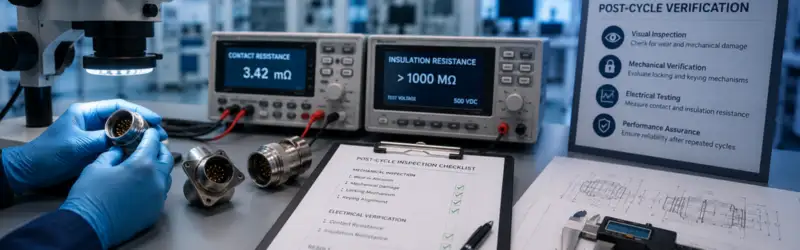
After completing the endurance cycles, the connectors undergo detailed inspection and verification. Engineers evaluate visible wear, mechanical damage, and the effectiveness of locking and keying mechanisms. Electrical parameters such as contact resistance and insulation resistance are also measured to verify that repeated mechanical operation has not affected connector performance.
The Engineering Mindset Behind the Project
What makes this project special is not just the machine itself, but the engineering mindset behind it. Every new customer requirement pushes us to learn, design, prototype, validate, and continuously improve. Instead of waiting for ready-made solutions, Envitest engineers develop testing capabilities that match international standards while remaining flexible for future applications.
Supporting Industry Demand for Reliable Connectors
As industries such as aerospace, defence, railways, automotive, telecommunications, and industrial electronics continue to demand more reliable interconnection systems, specialized qualification testing becomes increasingly important. By investing in new test facilities like the IEC 60512-9-1 endurance test system, Envitest Laboratories continues to strengthen its capability to support customers with world-class connector validation services.
Final Thoughts
At Envitest, every new testing requirement is not just another project — it is another opportunity to engineer the future of testing.