Modern vehicles are packed with electronics. From engine control units (ECUs) and battery management systems to sensors, cameras, actuators, and power electronics, today’s vehicles rely on hundreds of electronic components to operate safely and efficiently. While these systems are designed to perform flawlessly, they must also survive one of the harshest environments imaginable — the real world.
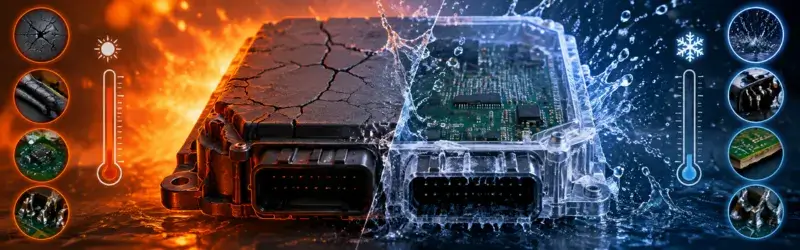
Imagine driving on a winter morning. The engine has been running for over an hour, and components under the hood have reached operating temperatures of 100°C or more. Suddenly, the vehicle passes through an icy puddle or slush-covered road. Within seconds, extremely cold water strikes components that were just moments ago operating at high temperatures. This sudden change in temperature creates a phenomenon known as thermal shock — and the ISO 16750-4 Splash Water Test is designed to validate whether automotive electronics can survive it.
What Is the ISO 16750-4 Splash Water Test?
ISO 16750-4 is an internationally recognized environmental standard for automotive electricalelectronic equipment. One of its most demanding evaluations is the splash water test, which reproduces the rapid temperature changes experienced by vehicle components during everyday driving.
Rather than relying on theoretical calculations, engineers recreate these conditions inside a controlled laboratory environment. The test asks a simple but critical set of questions:
- Can the enclosure survive?
- Will the seals remain intact?
- Will the PCB crack?
- Will solder joints weaken?
- Will moisture enter the electronics?
Simulating Real-World Road Conditions
The test begins by placing the Device Under Test (DUT) inside a temperature-controlled oven. The DUT is heated to its maximum operating temperature (Tmax) and maintained there for approximately one hour — or until thermal stabilization is achieved. At this stage, every part of the component has expanded due to heat.
Then comes the real challenge. Within less than 20 seconds, the hot DUT is removed and immediately subjected to an ice-water splash:
- Water temperature is maintained between 0°C and +4°C
- A controlled flow of 3–4 litres of water is sprayed over the component
- Spray duration is approximately 3 seconds
- Spray distance is 325 ± 25 mm
- This process is repeated 100 times
Test Parameters at a Glance
| Parameter | Specification |
|---|---|
| Initial DUT Temperature | Tmax (maximum operating temperature) |
| Heating Duration | Approx. 1 hour or until thermal stabilization |
| Water Temperature | 0°C to +4°C |
| Water Volume | 3–4 litres per splash |
| Spray Duration | Approx. 3 seconds |
| Spray Distance | 325 ± 25 mm |
| Transition Time (Hot to Splash) | Less than 20 seconds |
| Number of Cycles | 100 |
Why Is Thermal Shock So Dangerous?
Different materials expand and contract at different rates. An aluminium housing behaves differently from a plastic enclosure. Copper tracks expand differently from FR-4 PCB material. Rubber seals respond differently from metal fasteners.
When a hot component suddenly encounters near-freezing water, these materials contract almost instantly — but not equally. This creates internal mechanical stresses throughout the assembly. Over repeated cycles, these stresses can lead to:
- Cracks in plastic housings
- Seal degradation
- Moisture ingress
- PCB warpage
- Solder joint fatigue
- Connector damage
- Reduced insulation performance
- Premature field failures
More Than Just Water
Although the procedure appears straightforward, controlling every parameter is critical. Even small variations in water temperature, spray duration, flow rate, spray distance, transition time, or component temperature can influence the severity of the test and the validity of results.
Building Reliable Automotive Electronics
Passing the splash water test demonstrates far more than water resistance. It confirms that a component can survive repeated thermal shocks without compromising its mechanical integrity or electrical performance.
As automotive electronics become increasingly sophisticated — particularly with electric vehicles, ADAS, autonomous driving systems, and connected vehicles — the importance of environmental qualification continues to grow.
Envitest Laboratories: Supporting Automotive Reliability
At Envitest Laboratories, we help manufacturers validate automotive electronics against demanding international standards such as ISO 16750-4. Our environmental testing capabilities are designed to simulate real-world operating conditions, enabling engineers to identify weaknesses, improve product robustness, and enhance long-term reliability before products enter the field.
The test begins by heating the Device Under Test (DUT) to its maximum operating temperature (Tmax) inside a temperature-controlled chamber. Once the DUT reaches thermal stability, ice-water maintained between 0°C and +4°C is poured on the component in hot condition. This heating and rapid cooling sequence is repeated, creating severe thermal stresses similar to those encountered when a hot vehicle suddenly passes through icy puddles or slush. The test enables manufacturers to verify that components can withstand repeated thermal shocks without compromising their mechanical integrity or long-term reliability.
Final Thoughts
Automotive electronics are exposed to extreme environmental conditions throughout their service life. The ISO 16750-4 Splash Water Test exists because real-world reliability cannot be assumed — it must be proven.
By simulating the rapid thermal transitions that occur during normal vehicle operation, this test gives manufacturers the confidence that their components will perform reliably across thousands of operating hours and countless weather conditions.
Because in automotive engineering, reliability isn’t tested under perfect conditions. It is proven under the toughest conditions nature can create.