Almost everyone talks about Product Lifecycle Management (PLM) as a straightforward journey:
Design → Development → Process → Productivity → Cost → Delivery.
It is a familiar sequence. It is also incomplete.
Somewhere along the way, testing, reliability, sustainment and survivability are treated as supporting activities rather than core elements of the product lifecycle. That is where many products begin to accumulate risk.
A product is not successful simply because it has been designed correctly, manufactured efficiently, produced at the right cost and delivered on time.
The real test of a product begins after it leaves the factory.
- How will it behave in its actual operating environment?
- How long will it survive?
- What will fail first?
- What is the expected life?
- What are the predictable failure modes?
- What about the failures nobody predicted?
- How will the product be maintained?
- Can the failure be detected before it becomes catastrophic?
- Can the product be repaired, upgraded or sustained throughout its intended life?
- These questions are not post-delivery questions.
- They are PLM questions.
The first failure changes everything
Many organisations are extremely good at managing development schedules, production targets, cost and delivery commitments.
But when the first significant field failure occurs, suddenly everyone starts asking questions that should have been asked much earlier.
- Why did this fail?
- How did we not identify this during testing?
- How many other products are affected?
- Can we reproduce the failure?
- How long will it take to fix?
- What will it cost?
- Will the customer lose confidence?
And the damage caused by failure is rarely limited to time and money.
A customer who was confident in the product begins to question it.
The engineering team starts questioning previous design decisions.
Management starts questioning the development process.
The customer starts asking whether the next unit will fail.
Projects slow down. Decisions become conservative. Additional inspections and rework are introduced. Resources are diverted from new development into firefighting.
And perhaps most importantly, a constant fear of failure enters the system.
Testing should not be the final gate
Testing is often positioned at the end of the development cycle:
This approach makes testing a gatekeeper.
Instead, testing should be an engineering arm of PLM.
Testing should begin influencing the product much earlier—during design, architecture, component selection, prototyping and development.
Testing should help answer:
Can we make the product better?
Not simply:
Can we make the product pass?
Environmental testing, vibration, shock, thermal cycling, EMI/EMC, ingress protection, material evaluation, endurance, reliability and accelerated life testing are not merely compliance exercises.
They are opportunities to discover how the product behaves when reality becomes more demanding than the design assumptions.
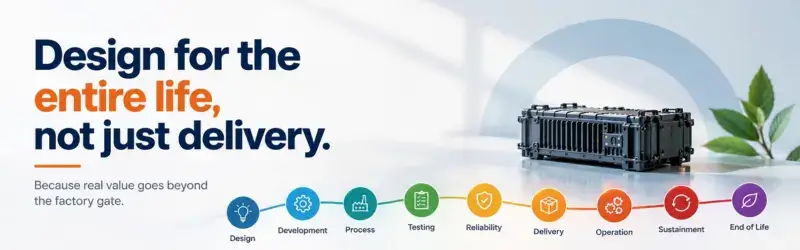
Design for the entire life, not just delivery
A product has a life after delivery.
PLM should therefore consider:
Testing becomes the bridge between what we expect the product to do and what it actually does.
The objective should not be to eliminate every possible failure—that is rarely realistic.
The objective is to understand failure, predict it where possible, detect it early, control its consequences and continuously improve the product.
A mature organisation does not wait for the customer to discover the failure.
It tries to discover the failure first.
Because by the time the customer finds it, the cost is no longer just the cost of repairing a product.
It may be the cost of lost time, lost money, lost progress, lost confidence and lost reputation.
That is why testing should no longer be viewed as an activity at the end of PLM.
Testing is one more arm of Product Lifecycle Management.
Test. Validate. Identify. Improve.
The earlier we understand how a product can fail, the better chance we have of building a product that survives its real life.