The Government of India’s approval of the ₹1.27 lakh crore Semicon 2.0 programme and the ₹62,500 crore Electronics Component Manufacturing (ECM) scheme marks one of the country’s biggest industrial policy initiatives in recent years. The objective is clear — to strengthen domestic capabilities in semiconductor packaging, printed circuit boards (PCBs), electronic components, and the broader electronics manufacturing ecosystem.
This naturally raises an important question: Can India now build complete products on its own? The answer is yes — but only if we look beyond manufacturing incentives.
Manufacturing Is Only One Piece of the Puzzle
Making a product involves much more than assembling components. Every successful electronic product passes through several stages:
- Product concept and system architecture
- Hardware and PCB design
- Firmware and software development
- Component sourcing
- Prototype development
- Mechanical design
- Qualification testing
- Certification
- Manufacturing
- Quality assurance
- After-sales support
The Real Challenge Is Components
Today, India assembles millions of electronic products every year. However, a significant portion of critical components — including advanced ICs, sensors, memory devices, RF modules, connectors, and passive components — are still imported.
Without this ecosystem, domestic manufacturing remains dependent on global supply chains.
Testing Must Grow Alongside Manufacturing
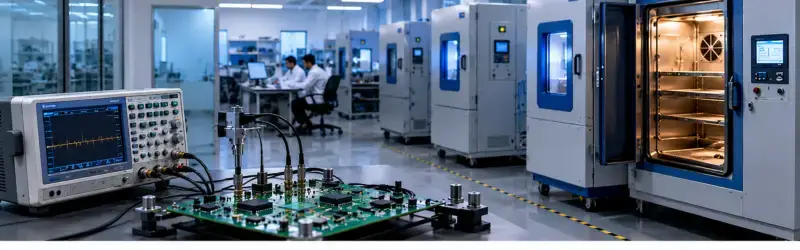
This is an area that often receives less attention. Every localized component must prove that it performs reliably under real-world conditions.
- Can it survive vibration?
- Will it withstand temperature cycling?
- How does it behave under humidity?
- Is it immune to electromagnetic interference?
- Will connectors survive thousands of mating cycles?
- Can the PCB operate reliably for years?
These questions cannot be answered by manufacturing alone. They require world-class qualification and validation infrastructure.
Design in India Must Become as Important as Make in India
India has one of the world’s largest engineering talent pools. Thousands of engineers design products for global companies. The next logical step is ensuring these engineers design products for Indian companies using Indian components manufactured within India.
This transition requires investment in:
- Product engineering
- R&D
- Design validation
- Prototype development
- Reliability engineering
The Missing Link: Long-Term Infrastructure
Building electronics infrastructure is capital intensive. A component factory, testing laboratory, or advanced manufacturing facility requires long-term investments. Many startups and MSMEs struggle because infrastructure costs are high while customer demand takes years to mature.
Why This Matters
- Every localized component reduces import dependence.
- Every domestically designed PCB increases engineering capability.
- Every validated product strengthens customer confidence.
- Every successful Indian product creates employment, develops suppliers, and encourages further innovation.
Final Thoughts
Semicon 2.0 provides a strong foundation. But its true success will not be measured only by the number of semiconductor facilities or component factories built. It will be measured by how many globally competitive products are conceived, designed, tested, manufactured, and exported from India.
India already has the engineers. The government is now investing in manufacturing. The next step is connecting design, manufacturing, testing, validation, and innovation into one integrated ecosystem.
Only then can we confidently say that India is not just assembling products — it is creating products for the world.