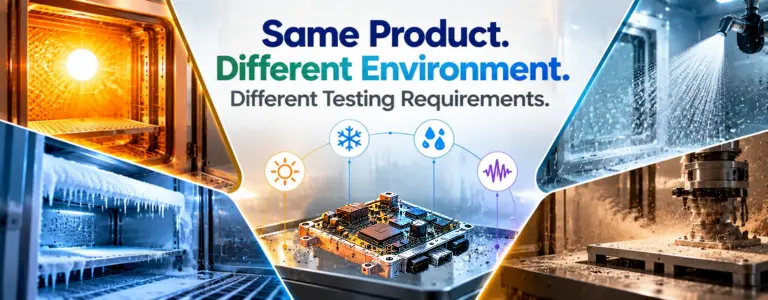
A common assumption in product testing: “If a product has been tested once against a particular standard, that same test programme should be suitable everywhere.” In reality, this assumption can lead to critical field failures or unnecessary development costs.
The basic product structure may remain completely unchanged, but its testing requirements shift dramatically depending on where it is used, how it is used, who is using it, and what conditions it is expected to withstand.
Case Study: The Electronic Control Unit (ECU)
To understand why environment-driven testing is crucial, consider an Electronic Control Unit (ECU) installed across three distinct operational environments:
| Deployment Environment | Environmental Profile & Stresses | Primary Risk Factors |
|---|---|---|
| Indoor Control Panel | Stable temperatures, controlled moisture, minimal dust, low mechanical stress. | Minor thermal degradation, basic dielectric concern. |
| Outdoor Industrial Machine | Rain, humidity, dust ingress, wide ambient temperature variations. | Moisture ingress, corrosion, seal degradation, thermal shock. |
| In-Vehicle / Automotive | Multi-axis dynamic vibration, mechanical shock, thermal cycling, transient electrical conditions. | Solder joint fatigue, connector fretting wear, structural fracture. |
The product has not changed, but the risks associated with its application have changed completely. Applying a static environmental testing procedure without accounting for these specific risk profiles leaves critical vulnerabilities exposed.
Sector-Specific Demands and Industrial Applications
Operating environments bring unique reliability expectations, regulatory mandates, and failure consequences across key industrial sectors:
- Automotive & Transportation: Demands rigorous dynamic stress evaluations including vibration testing and extreme mechanical shock.
- Railway & Defence: Requires high structural integrity against continuous low-frequency vibrations and severe thermal shifts.
- Aerospace & Marine: Calls for aggressive salt spray/corrosion resistance combined with altitude and pressure differential evaluations.
- Telecom & Outdoor Infrastructure: Prioritizes long-term ingress protection (IP), water resistance, and cyclic temperature-humidity endurance.
Component Deep Dive: Connectors in Action
Even within the same industry, specific applications create vastly different failure mechanisms for identical components:
Protected Cabinet Connector
Limited exposure to environmental stresses. Focus remains primarily on basic electrical ratings and contact resistance.
Outdoor Machine Connector
Faces water, dust, corrosion, dynamic temperature swings, and light vibration. Requires strict environmental sealing checks. Read our climatic connector testing guide to learn more.
Moving Vehicle Connector
Subjected to continuous mechanical vibration, shock loads, and high thermal cycling. Demands thorough structural and environmental validation.
Balancing Compliance, Cost, and Reliability
Standards provide essential testing methodologies, severities, procedures, and acceptance criteria. However, treating standards as rigid checklists without considering real-world applications creates two distinct operational hazards:
- Over-Testing (Unnecessary Cost & Delay): Testing every possible parameter for every application increases development cost, time, and certification effort without providing additional technical value.
- Under-Testing (Unidentified Weaknesses): Selecting too few tests or ignoring application-specific conditions leaves critical weaknesses unidentified before field deployment.
Why Differing Customer Requirements Are Valid
It is common for two clients purchasing the exact same base product to request completely different test schedules. Both requirements can be technically valid:
- Client A (Rotating Machinery): Focuses on vibration profiles to prevent mechanical fatigue.
- Client B (Coastal Deployment): Focuses on cyclic corrosion and salt fog exposure to ensure coating integrity.
- Client C (Outdoor Electronics): Focuses on combined thermal and humidity cycling to prevent condensation failures.
The Envitest Lab Approach
At Envitest Lab, we believe the first conversation should not simply be “Which standard do you want us to test against?” Instead, it should be:
1. Where will the product be used?
2. How will it be used in service?
3. What exact conditions and stresses will it experience?
These questions help identify the relevant standards and, more importantly, the relevant tests that provide meaningful evidence of performance and durability. Explore our full range of testing services or view our complete site index for more details.
Ultimately, the goal of testing is not to produce the biggest possible test report. The goal is to generate relevant technical evidence that your product can perform reliably in its intended real-world environment.
Right Tests. Right Conditions. Right Confidence.
Envitest Lab — Testing Beyond Compliance.