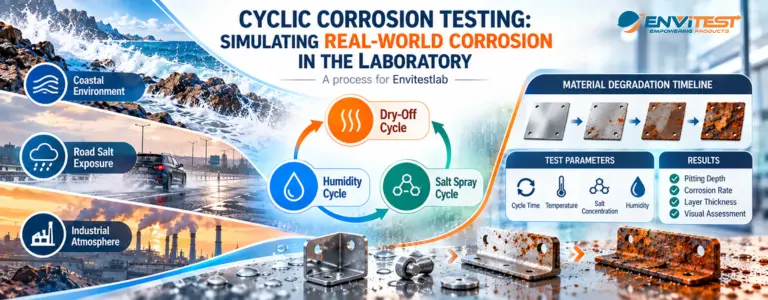
Corrosion rarely happens under one constant condition. In the real world, a product experiences salt, moisture, high humidity, heat, drying cycles, and temperature changes repeatedly throughout its service life. Cyclic Corrosion Testing (CCT) reproduces these dynamic environmental conditions in a controlled laboratory setting.
At Envitest Lab, our expertise in corrosion testing allows us to go beyond simply exposing a sample to static salt spray. We understand that real-world corrosion is heavily influenced by the combination and sequence of environmental stresses. CCT provides a controlled way to reproduce these transitions, accelerating the exact degradation mechanisms products experience in service.
Traditional Salt Spray vs. Cyclic Corrosion Testing (CCT)
Traditional salt spray testing continuously exposes a specimen to a salt-laden atmosphere. While useful for specific quality benchmarks, real operational environments are far more dynamic.
| Testing Parameter | Traditional Salt Spray Testing | Cyclic Corrosion Testing (CCT) |
|---|---|---|
| Atmospheric State | Continuous, unbroken salt fog exposure. | Dynamic multi-phase cycles (fog, dry, high humidity). |
| Environmental Transition | Static temperature and moisture levels. | Active cycling of temperature, humidity, and moisture state. |
| Real-World Realism | Limited; creates artificially saturated corrosion. | High; reproduces real field wetting and drying sequences. |
| Failure Mechanisms | General surface rust formation. | Blistering, delamination, under-film corrosion, and joint failure. |
Anatomy of a CCT Sequence in the Laboratory
In a CCT chamber, environmental conditions are programmed into a defined, repeatable cycle. A typical testing sequence involves three core environmental phases:
1. Salt Fog / Spray Phase
Exposes components to direct salt fog solution, initiating surface oxidation and initial chemical contact.
2. Forced Drying Phase
Introduces warm air circulation to dry moisture. Salt crystallizes on surfaces and cracks, accelerating stress corrosion.
3. High-Humidity Phase
Maintains elevated humidity and condensation levels. Re-activates crystallized salt deposits, causing deep blistering and corrosion propagation.
This sequence is repeated for a specified number of cycles or durations according to globally recognized test specifications (such as ASTM B117, ISO 9227, or SAE J2334).
Failure Modes Identified Through Cyclic Testing
The repeated wetting, drying, thermal shifts, and humidity transitions inherent to CCT promote specific corrosion failure modes much earlier than natural weathering:
- Rust Formation & Oxidation: Accelerated breakdown of untreated metallic base materials.
- Coating Blistering: Moisture entrapment beneath paint or protective film layers.
- Under-Film Corrosion: Lateral creepage of rust beneath adjacent coating systems.
- Coating Delamination: Complete loss of adhesion between protective layers and substrates.
- Stress & Joint Cracking: Interfacial failure at fastener joins, sharp edges, and weld points.
A Critical Engineering Note on Conversion Factors:
Accelerated testing should never be converted directly like “X days in the chamber equals X years in the field.” The exact correlation depends on the substrate material, coating system, operating environment, and specific failure mechanisms. CCT’s primary strength is providing a controlled, repeatable baseline to compare materials, surface treatments, and designs.
Where CCT Adds Value Across the Engineering Lifecycle
Cyclic Corrosion Testing serves as a critical engineering tool across multiple stages of product development and quality assurance:
- Product Development & R&D: Evaluate novel alloy compositions, coating formulations, and plating techniques.
- Supplier Qualification: Validate raw material batches and verify third-party coating quality before assembly.
- Process & Coating Validation: Determine if surface preparation, cleaning, or cure changes compromise long-term durability.
- Failure Investigation: Replicate premature field failures in a laboratory environment to analyze root causes and design effective fixes. Learn more about our specialized inspection services for failure analysis.
Targeted Vulnerabilities: Interfaces, Edges, and Fasteners
For complex automotive, aerospace, and industrial assemblies, corrosion rarely occurs uniformly across open, flat surfaces. It typically originates at structural vulnerabilities:
Identifying where corrosion begins—and how fast it propagates across these critical features—provides engineers with actionable data to refine mechanical designs and coating applications. Check out our detailed guide on climatic testing for electrical connectors to see how structural interfaces are evaluated.
The Envitest Lab Approach
At Envitest Lab, our approach is not merely to “put the sample in the chamber.” We collaborate directly with your team to understand the component, substrate material, coating system, intended operational environment, and probable failure risks.
We carefully define exposure sequences, specimen preparation, and post-test evaluation criteria to generate technically sound, actionable reports. Explore our full range of simulated environmental testing capabilities or consult our complete site index to learn more about our NABL-accredited facilities.
It is about understanding how materials respond to changing environmental stresses and eliminating structural weaknesses before they turn into costly field failures.
Right Tests. Right Conditions. Right Confidence.
Envitest Lab — Testing Beyond Compliance.